
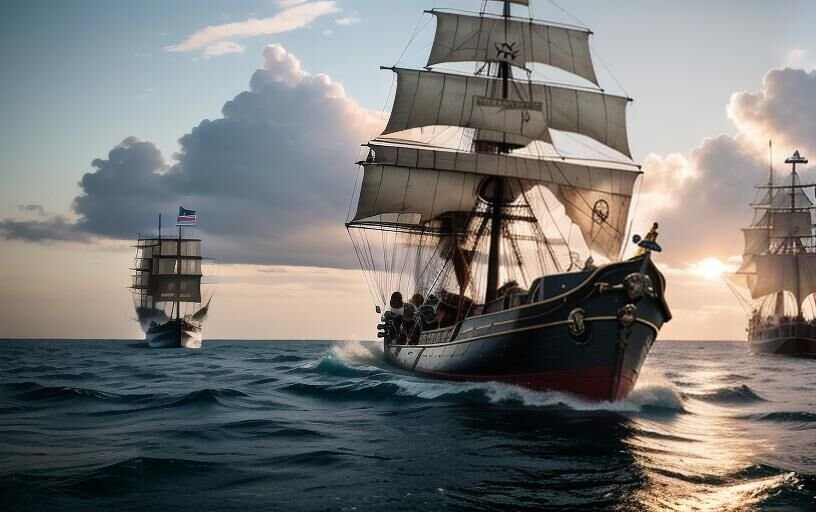
Introduction
If you want the real story of Edward Teach, you have to accept an annoying truth up front: the verified biography is thin, the timeline is real, and the “Blackbeard” we picture, smoking fuses in his beard like some haunted volcano, is partly a marketing campaign that got away from him. We can document where he operated, who hunted him, what he seized, and how he died at Ocracoke Island in 1718. What we cannot do is narrate his childhood, thoughts, or even his exact birthplace with the confidence people bring to a Netflix recap.
That gap is where the legend grows teeth.
And it’s also where Teach, a ruthless captain with a flair for theater, probably wanted you to live.
What do we know for sure about Teach?
Names and aliases
Primary records don’t give us one neat name tag. You’ll see Teach, Thatch, Thache, even spellings that look like a clerk got bored mid-sentence. That’s normal in early 18th-century paperwork, especially across colonies, ports, and languages.
Here’s the practical way to read it: if the date, associates, and location line up, you’re probably looking at the same pirate captain, even if the spelling doesn’t.
| Name form in records | Where it shows up (examples) | What it tells us |
|---|---|---|
| Teach | Later English-language accounts, modern convention | The standardized version historians tend to use |
| Thatch / Thache | Colonial correspondence and early references | Period spelling drift, not a “different guy” |
| Edward Thache | Some compiled biographies and transcriptions | A common formalized variant tied to the same figure |
If you want a careful, scholarly overview of the name mess (and the Hornigold apprenticeship question), the NC-focused biography at this NCpedia profile handles it without romance-novel filler.
Birthplace evidence
The popular line is that he was from Bristol, England. It’s plausible. It’s also not locked down the way people claim at parties. Bristol was a major maritime city, the kind of place that produced sailors, privateers, and men who knew the difference between a sloop and a floating coffin.
The better way to say it, if you care about documented history, is: Teach appears to have been English, and he surfaces in Atlantic-world records as a working seaman turned pirate, likely after experience in wartime privateering. The Royal Museums Greenwich breakdown of privateers sliding into piracy is useful here because it frames Teach as a product of policy and war, not a random gothic villain spawned by the sea.
Key primary records
The record is strongest when other people are complaining about him, pursuing him, or testifying under oath. That’s the stuff that survives. If you’re trying to separate fact from legend, you keep coming back to a small set of “boring” documents that are, frankly, more trustworthy than any dramatic anecdote.
A solid short list looks like this:
- Victim depositions and court-related testimony describing captures, threats, and stolen cargo
- Letters between colonial governors and naval officers, especially around enforcement and jurisdiction
- Reports tied to the final campaign in North Carolina waters, including the chase and aftermath
- Modern archaeological reporting tied to the Queen Anne’s Revenge wreck site and its recovered material culture
North Carolina’s own archive of letters and reports, including the operational paper trail around his defeat, lives inside the North Carolina Digital Collections “pirate papers” set. It’s not “fun,” exactly. It’s real.
Which sources separate fact from legend?
Trial depositions
Depositions are where you catch Teach in the act, indirectly. Not because the witnesses were saints. Because these statements were made in legal contexts where details mattered: ship names, cargo types, numbers of men, weapons, threats, locations along the coast.
They’re also limited. A frightened sailor describing a boarding is not writing a psychological profile. He’s describing how fast his merchant vessel went quiet when a black flag showed up and the pirate crew looked organized enough to make resistance feel like a hobby for fools.
Colonial correspondence
Letters between governors, customs officials, naval officers, and London-facing administrators show the politics behind the piracy. The colonies didn’t share one clean enforcement machine. They were a patchwork of local ships, private interests, and petty rivalries, with the Royal Navy stretched thin and often busy elsewhere.
That’s why Teach could operate like a moving corporate office, floating between jurisdictions, collecting intelligence, leaning on favors, and exploiting the enforcement gaps. The National Park Service profile keeps its language conservative, which I respect, and still makes the basic point: his Atlantic coast presence mattered enough that officials treated him as more than a tabloid nuisance.
Captain Johnson problem
If you’ve ever read A General History of the Pyrates (1724), usually attributed to “Captain Charles Johnson,” you already know the problem. It’s vivid. It’s influential. It’s also slippery. It helped staple the nickname Blackbeard to the cultural wall permanently, along with the beard theatrics and the aura of monstrous evil.
Some of it likely draws on real accounts. Some of it smells like narrative convenience, stitched together for readers who wanted sea battles and moral lessons. If you want a decent, cited primer on how that book shaped the scary image, this ThoughtCo biography discussion lays out the issue without pretending we can solve authorship debates with vibes.
How did war and empire enable piracy?
Privateering pipeline
Queen Anne’s War (part of the War of the Spanish Succession) trained a generation of sailors in sanctioned violence. Privateer commissions made raiding feel legal as long as you had the right paperwork and the right enemy flag. Then peace arrives, commissions dry up, sailors still need wages, and the sea is full of fat trade routes.
That’s your pipeline. You don’t need a cartoon origin story. You need demobilized maritime labor, idle guns, and an empire that can’t patrol every bay and inlet.
Caribbean trade routes
The Caribbean was the economic engine room: sugar, rum, indigo, cocoa, logwood, enslaved Africans moved through the slave trade, and constant inter-island shipping that couldn’t afford to sail like a fortress. Places like Martinique mattered. So did St Lucia and St Vincent as points on the mental map of the West Indies, even when Teach’s best-documented operations cluster around the Bahamas and the Carolinas.
Piracy thrives where predictable commerce meets limited protection. That’s not a moral claim. That’s just logistics.
Colonial enforcement gaps
Colonial politics weren’t unified. Governors had competing incentives, merchants wanted profit, some officials wanted plausible deniability, and everyone wanted the mess to be somebody else’s job. Enforcement wasn’t only about catching pirates. It was about who had authority to do it, who paid, who got credit, and who got to keep seized goods.
A smart pirate captain watches that chaos the way a day trader watches price swings.
How did he build power fast?
Nassau network
Nassau, in the Bahamas, functioned like an incubator for pirate activity after the war. You had crews, repair yards, black-market outlets, and fellow pirates swapping intel. Teach’s association with Benjamin Hornigold matters here. Hornigold is the kind of operator who shows you how to run a pirate career like a business: capture, recruit, refit, resupply, repeat.
Then Woodes Rogers arrives with the mission to clamp down and offer pardons, and suddenly the whole ecosystem has to adapt or die.
La Concorde capture
Teach’s leap into top-tier infamy is tied to taking La Concorde, a French ship used in the transatlantic slave trade, and converting it into his flagship. That one act has everything: violence, opportunism, maritime skill, and a brutal connection to the Atlantic economy that polite pirate myths like to blur.
Once renamed, the Queen Anne’s Revenge wasn’t just a ship. It was a floating press release.
The excavation hub at the Queen Anne’s Revenge project site is one of the best reality checks we have because it forces the legend to answer to iron, wood, and ballast.
Flagship and firepower
When you hear “40 guns,” don’t picture a neat, uniform warship broadside like a museum model. Picture a pirate-optimized weapon system: intimidating enough to make targets fold early, flexible enough to chase with smaller sailing boats and sloops, staffed by sailors who understood that reputation saves you ammunition.
Teach’s real superpower might have been this: he didn’t need to fight much if he could make you believe he would.
A few concrete levers he pulled, fast:
- He attached himself to proven operators and absorbed the Nassau network’s knowledge.
- He scaled intimidation with a flagship that looked like a problem you didn’t want.
- He used alliances tactically, including with Stede Bonnet, when it suited the moment.
- He treated spectacle like a weapon, not a costume.
That “branding as strategy” argument isn’t just modern snark, either. Academic work on his constructed imagery, like this UW-repository thesis on myth and reality in Blackbeard imagery, basically says the quiet part out loud: terror is cheaper than battle.
What happened at Charles Town in 1718?
The Charles Town (Charleston) blockade is one of the cleanest examples of Teach using optics to force compliance. He didn’t just grab ships. He froze a major port long enough to make the colonies feel, in their bones, that maritime security was a joke.
The demand that sticks in the record is medical supplies, which is such a weirdly specific detail that it reads as real. It also hints at the unglamorous truth of pirate life: disease, injury, and the constant need to keep a crew functional.
A lot of popular retellings make this episode sound like pure swagger. It was that, sure. It was also a sophisticated move that exploited merchant panic, port dependency, and the fact that any delay in Atlantic trade could ripple into real financial pain. If you want a punchy modern summary that leans into the spectacle side, HistoryExtra’s take on his legend mechanics captures why this moment welded myth to reality so tightly.
Why did the Ocracoke fight end it?
Because politics caught up with him, and because a determined lieutenant didn’t play the part Teach expected.
Virginia governor Alexander Spotswood pushed the operation that sent Lieutenant Robert Maynard after Teach, even though the showdown happened in North Carolina waters. That detail matters. It’s not just “the law” versus “the pirate.” It’s inter-colony power, ambition, and the desire to look effective in a world where piracy made leaders look weak.
The fight at Ocracoke wasn’t a cinematic duel. It was close-quarters chaos after maneuvering in shallow water, with Maynard’s men using deception to survive the initial hit and then swarming. Teach died there in November 1718. His head was taken as proof. That’s grim, and it’s also how you end a legend in an age that demanded receipts.
Modern archaeology adds another twist: the Queen Anne’s Revenge wreck, near Beaufort Inlet, has generated a whole argument about whether the grounding was an accident or something more strategic. Studies discussing microartifacts and site interpretation, like this Carleton shipwrecks research page, show how physical evidence can re-open old questions without turning them into fan fiction.
If you want the artifacts to do the talking, the QAR artifact database is a rabbit hole: medical tools, navigation gear, guns, the mundane hardware of a working, violent enterprise. The Smithsonian’s broader context on life in the Atlantic world, including pirate psychological tactics, also helps anchor the story in reality at this Smithsonian exhibition page.
FAQ
Was Blackbeard’s beard really on fire?
The “burning beard” image comes from descriptions of slow-burning fuses tucked under a hat or into hair to create smoke. It’s plausible as intimidation theater, and it fits his reputation, but the exact staging is hard to verify like a lab result. What’s verifiable is that witnesses remembered the look, and that’s the whole point of the tactic.
Did Edward Teach actually kill a lot of people?
He was violent and he ran a predatory operation, but the popular image of nonstop slaughter is exaggerated. A big chunk of pirate success relied on surrender without a fight. Teach’s intimidation reduced resistance, which reduced casualties, which also reduced damage to valuable ships and cargo.
Was he basically a “genius marketer”?
Not in the modern, cute sense. He was an operator who understood signaling. The nickname Blackbeard worked like a weaponized rumor. The costumes, the flagship, the staged ferocity all made it more likely that a target would comply quickly. The Southern Adventist research on terror as a pirate weapon gets at the same mechanism without the influencer-language.
Did he take a pardon and go legit?
He accepted a royal pardon in North Carolina under Governor Charles Eden and spent time around Bath, which is documented well enough that even tourism history sticks close to the record, like this walkable overview of his North Carolina pardon-era footprint. “Go legit,” though, is generous. The period reads more like strategic lying low mixed with continued shady dealing.
Do we know anything new about his identity?
“New” is relative, but genealogical work keeps tightening the frame. North Carolina’s own cultural resources department summarized one wave of findings in its “Blackbeard Reconsidered” press release, which is a good example of how modern research often clarifies small things rather than rewriting the whole story.
Conclusion
Edward Teach is documented enough to place him firmly in the Atlantic world: a sailor shaped by war, a pirate captain who scaled fast through alliances, firepower, and psychological warfare, and a man whose career peaked in 1717 to 1718 before collapsing under colonial retaliation and political pressure. The legend, though, is louder than the file folder, because he built it that way and because early popular sources poured gasoline on the image.
So if you’re a history lover looking for real pirate stories, the move is simple and a little brutal: trust depositions, letters, and the archaeological record; treat the rest like performance notes from a very successful, very deadly show.
Why Destin Is the Perfect Pirate Festival Destination
What makes Destin the perfect pirate festival destination is that it combines crystal emerald waters, expansive sandy beaches and a spirited festival atmosphere. The town puts on family-friendly events like pirate-themed parades, live music and local food stalls....
Famous Pirate Ports and Their Secrets
Key Takeaways 1. Port Royal, Jamaica 2. Tortuga, Haiti 3. Nassau, Bahamas 4. San Juan, Puerto Rico 5. Cartagena, Colombia 6. Charleston, South Carolina 7. St. Mary's, Maryland 8. Acapulco, Mexico 9. Plymouth, England 10. Madagascar's Pirate Coast Conclusion Frequently...
Pirate Festival Costumes, Accessories & Styling Tips
Key Takeaways Beyond the Outfit 1. Community 2. Identity 3. Immersion 4. Storytelling 5. Connection Pirate Archetypes The Classic The Fantastical The Historical The Modern Crafting Authenticity Historical Research Material Choices Creative Freedom Festival Adaptation...